

Quick Answer
What is a Real Property Report in Calgary? A Real Property Report, often called an RPR, is a legal survey document prepared by an Alberta Land Surveyor. It shows the property boundaries and the location of visible improvements such as the house, garage, deck, shed, fence, and other structures in relation to those boundaries. In a Calgary sale, an RPR can help buyers, sellers, lawyers, lenders, and the City review property layout and potential municipal compliance issues before closing. Bare land condominiums with improvements may also require an RPR, unlike most conventional apartment-style condos.
If you are selling a detached home, semi-detached home, townhouse-style bare land condo, or another property where you own the land or a defined bare land condominium unit, the Real Property Report can become one of the most important documents in the transaction. It does not tell a buyer whether the furnace is old, whether the roof needs work, or whether the home was renovated well. Instead, it answers a different question: does the physical layout of the property match what is legally and municipally expected?
That matters because last-minute RPR issues can create stress during a sale. A missing document, outdated survey, unshown deck, fence encroachment, or compliance question may lead to extra lawyer review, buyer concerns, negotiation pressure, or closing delays. Reviewing the RPR before listing gives you more control over the process instead of discovering a problem after you already have an accepted offer.
What Does a Real Property Report Look Like?
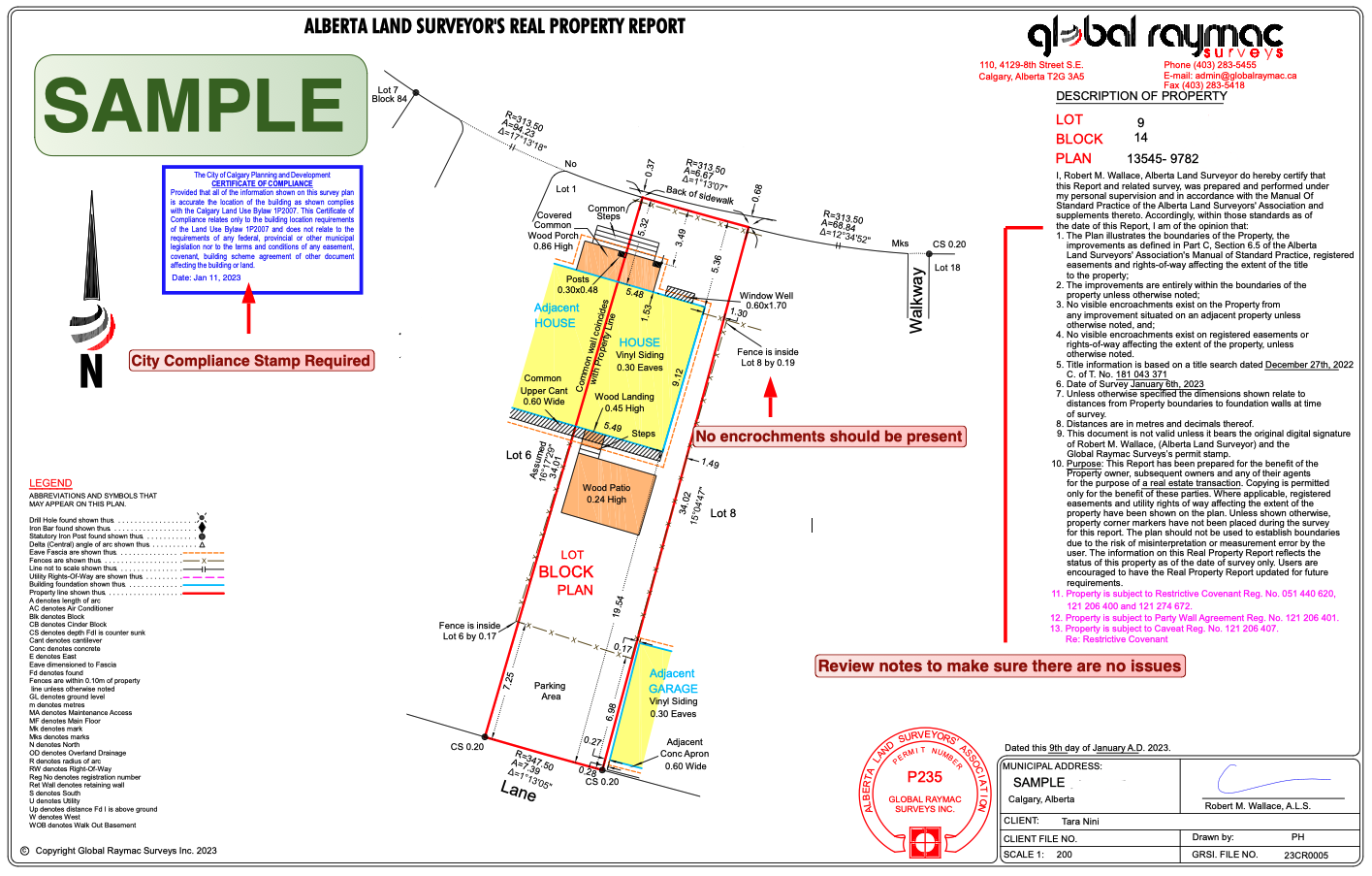
A Real Property Report usually looks like a detailed survey drawing of the lot. It may show the property shape, property lines, measurements, buildings, garage, deck, fences, window wells, sidewalks, easements, rights-of-way, survey notes, and the Alberta Land Surveyor’s certification. If municipal compliance has been reviewed, the report may also include a City compliance stamp or related compliance wording.
The sample below shows how an RPR can appear in practice. It includes the property outline, labelled improvements, measurements from structures to property lines, notes about fences and adjacent structures, a legend of symbols, surveyor certification details, and a City of Calgary compliance section.
What is a Real Property Report?
A Real Property Report is a legal survey document prepared by an Alberta Land Surveyor. It shows a property from a survey perspective, including the property boundaries and the location of visible improvements on the land. These improvements can include the home, garage, shed, deck, fence, retaining wall, window wells, air conditioning units, and other visible structures, depending on the property.
For Calgary homeowners, the easiest way to think about an RPR is this: it is a professional survey drawing that shows where the property starts and ends, where the structures sit, and whether anything appears to cross boundaries or conflict with municipal land use rules.
| RPR Item | What It Means | Why It Matters When Selling |
|---|---|---|
| Legal Details Municipal address and legal land description |
Identifies the specific parcel of land being surveyed. | Helps lawyers and buyers confirm the document matches the property being sold. |
| Boundaries Property lines and dimensions |
Shows the surveyed limits of the property. | Helps identify whether structures or fences appear to cross onto neighbouring land or municipal property. |
| Improvements Home, garage, deck, shed, fence, and other visible structures |
Shows where visible improvements sit in relation to the boundaries. | Buyers can see whether the current property layout is accurately reflected. |
| Encroachments Items crossing or near property lines |
Identifies visible structures that may extend beyond the property boundary. | May require lawyer review, neighbour discussion, agreement, removal, or another negotiated solution. |
| Easements Utility rights-of-way or other registered interests |
Shows areas where another party may have access or rights over part of the property. | Buyers need to understand restrictions that could affect use, landscaping, or future improvements. |
| Surveyor Certification Surveyor signature, date, and certification |
Confirms the report was prepared by a qualified Alberta Land Surveyor. | An altered, unsigned, outdated, or mismatched RPR may not be accepted for review. |
RPR vs Home Inspection: What is the Difference?
A Real Property Report and a home inspection are both useful, but they are not the same document.
An RPR focuses on location and boundaries. It shows where visible structures sit on the lot, whether there are apparent encroachments, and whether the property may need municipal compliance review. A home inspection focuses on condition. It looks at the roof, foundation, plumbing, electrical, heating, insulation, ventilation, drainage, and other physical components of the home.
| Question | Real Property Report | Home Inspection |
|---|---|---|
| Who prepares it? | An Alberta Land Surveyor. | A home inspector. |
| What does it check? | Boundaries, visible structures, encroachments, easements, and layout. | Condition of the home, systems, safety concerns, and maintenance issues. |
| Does it assess building condition? | No. It is not a condition inspection. | Yes. That is the purpose of the inspection. |
| Why does it matter to sellers? | It can reveal boundary or municipal compliance issues before closing. | It can reveal repair or maintenance concerns before negotiation. |
When preparing your Calgary home for sale, it is smart to think about both sides. The RPR helps with property layout and compliance clarity. A pre-listing inspection may help identify condition issues before buyers discover them.
Why a Real Property Report Matters When Selling in Calgary
An RPR matters because it can affect buyer confidence, lawyer review, lender requirements, municipal compliance, and closing timelines. In many Calgary freehold transactions, buyers expect the seller to provide a current RPR, often with evidence of municipal compliance where applicable. The exact obligation depends on the purchase contract, property type, and legal advice, so sellers should confirm their specific situation with their REALTOR® and real estate lawyer.
From a practical seller perspective, the biggest benefit of reviewing the RPR early is control. If the RPR is missing, outdated, or shows an issue, you may still have options. The difference is whether you find out before listing or after a buyer is already waiting for documents.
Seller takeaway: An RPR is not just paperwork. It can affect negotiation leverage, buyer confidence, and whether your closing process stays on track.
Who Needs a Real Property Report?
Sellers of Detached, Semi-Detached, and Freehold Homes
If you are selling a Calgary home where the land and exterior improvements are part of the property being transferred, you should review your RPR early. If the document is current and accurately reflects the property, it may help support a smoother sale. If it is outdated or incomplete, early review gives you time to speak with a surveyor, lawyer, or the City before it becomes urgent.
This is especially important if you have added a garage, deck, shed, fence, addition, hot tub, retaining wall, air conditioning unit, or other visible improvement since the RPR was prepared.
Bare Land Condominium Sellers
Bare land condominiums are an important exception to the common belief that condos do not need Real Property Reports. A conventional apartment-style condominium usually does not require an RPR because the unit is typically an interior space within a building. A bare land condominium is different because the condominium unit is the land itself, often with a house, garage, driveway, deck, fence, or other improvements built on it.
If a bare land condominium unit has improvements on it, an RPR with evidence of municipal compliance or non-conformance may be required as part of the transaction. This can apply to townhouse-style bare land condos, detached bare land condo homes, villa-style developments, and other properties where the owner controls a defined parcel of land within a condominium plan.
If you are selling a bare land condo in Calgary or elsewhere in Alberta, do not assume the condo label means an RPR is unnecessary. Confirm the property type, contract requirements, and RPR expectations with your REALTOR® and real estate lawyer before listing.
Buyers
Buyers use the RPR to understand what they are buying. It can help identify boundaries, visible structures, easements, rights-of-way, and possible encroachments. It can also help a buyer and their lawyer understand whether the property layout may require additional review before closing.
Owners Planning Renovations or Boundary Work
You may also need an RPR or survey advice if you are planning a major renovation, building a garage, adding a deck, changing fences, resolving a boundary dispute, or preparing for future resale. In those situations, a surveyor can help clarify what type of survey information is appropriate.
| Property Type | Is an RPR Commonly Needed? | Seller Notes |
|---|---|---|
| Detached Freehold Home Typical house on its own titled lot |
Yes, commonly expected in many Alberta resale transactions. | Review early, especially if exterior improvements have changed. |
| Semi-Detached Freehold Duplex or attached home with titled land |
Often yes, depending on the contract and property. | Pay close attention to shared walls, fences, garages, decks, and boundary details. |
| Bare Land Condo With Improvements Land is the condominium unit |
Yes, this is the major condo exception. | Confirm RPR and compliance expectations before listing. |
| Conventional Apartment Condo Interior unit in a building |
Usually no. | Condo documents, bylaws, financials, and reserve fund information are usually more relevant. |
| Vacant Bare Land Condo Unit No structures on the unit |
May differ from an improved unit. | Confirm with your lawyer because requirements may depend on whether improvements exist and what the contract says. |
Real Property Reports and Calgary Certificates of Compliance
In Calgary, RPRs are often discussed together with a Certificate of Compliance. A Certificate of Compliance is a City of Calgary confirmation that the location of structures shown on the RPR complies with the Land Use Bylaw. It is important to understand what this does and does not mean.
A compliance review is based on the RPR and focuses on the location of structures in relation to municipal land use rules. It is not the same as a home inspection, and it is not a general confirmation that all building code, permit history, renovation quality, or construction details are acceptable.
| Document | What It Confirms | What It Does Not Confirm |
|---|---|---|
| Real Property Report Prepared by an Alberta Land Surveyor |
The surveyed boundaries and location of visible improvements relative to those boundaries. | The physical condition of the home, renovation quality, or whether every improvement has all required permits. |
| Certificate of Compliance Reviewed by the City of Calgary |
That the location of structures shown on the RPR complies with the City’s Land Use Bylaw, based on the review. | Building code compliance, home condition, permit history, or whether the property has no future issues. |
| Home Inspection Prepared by a home inspector |
Condition observations about visible and accessible home systems and components. | Survey boundaries, municipal land use compliance, or legal title matters. |
If you are unsure whether your RPR is acceptable for a Calgary sale, ask your real estate lawyer and REALTOR® to review the contract requirements. If the RPR needs municipal review, contact the City of Calgary or a qualified professional for current submission requirements.
Common Issues That May Show Up on an RPR
An RPR does not automatically mean there is a problem. Many properties have straightforward reports. But when issues do appear, they are usually easier to manage before listing than during the final days before closing.
| Possible Issue | What It Means | Seller Action to Consider |
|---|---|---|
| Encroachment A structure crosses or appears to cross a boundary |
A fence, shed, garage, deck, or other item may extend onto neighbouring land or municipal property. | Speak with your lawyer and surveyor. The solution may involve removal, permission, an agreement, or another negotiated approach. |
| Setback Concern A structure appears too close to a property line |
The location may not align with current municipal land use rules. | Confirm with the City or a qualified professional before assuming the structure must be removed. |
| Missing Improvement A newer structure is not shown |
The RPR may be outdated because something was added after the survey date. | Contact an Alberta Land Surveyor to ask whether an update or new RPR is needed. |
| Easement or Right-of-Way Part of the property is subject to registered access rights |
Utilities, drainage, or other parties may have rights affecting part of the land. | Disclose clearly and have your lawyer explain how it affects the property. |
| Altered or Illegible RPR The document may not be acceptable for review |
Marked-up, unsigned, incorrect, or unclear documents can create problems. | Get a clean copy or contact the original surveyor if available. |
How to Get a Real Property Report in Calgary
To get a Real Property Report, contact an Alberta Land Surveyor. If you already have an older RPR, start by finding the most recent copy and checking whether the property has changed since it was prepared. If you have added or removed structures, the document may no longer be current.
A surveyor may ask for your municipal address, legal land description, title information, existing RPR if available, and details about improvements on the property. The surveyor can then explain what type of update or new report may be required.
Seller RPR Preparation Checklist
- Find the most recent RPR for your property.
- Confirm whether your property is freehold, conventional condominium, or bare land condominium.
- Compare the RPR to the current property layout.
- Check whether decks, fences, sheds, garages, additions, window wells, retaining walls, or air conditioning units have changed.
- Ask whether the RPR has a City of Calgary compliance stamp or related compliance documentation.
- If anything has changed, speak with an Alberta Land Surveyor before listing.
- If the issue is legal or contract-related, speak with your real estate lawyer.
- If the issue is municipal compliance-related, confirm the current process with the City of Calgary or a qualified professional.
Because surveyor availability, property complexity, and municipal review processes can change, avoid relying on old timing or cost assumptions. Ask for a current quote and timeline from the surveyor before making listing or closing plans.
How Long is a Real Property Report Valid?
A Real Property Report does not work like a driver’s licence with a fixed expiry date. Its usefulness depends on whether it still accurately reflects the property. If the physical improvements on the land have changed since the RPR was prepared, it may need to be updated or replaced.
Common changes that may make an older RPR less useful include adding a deck, garage, shed, fence, addition, retaining wall, hot tub, air conditioning unit, or other visible improvement. Removing structures can also matter because the current property may no longer match the old survey.
If you are selling your home and you are unsure whether your old RPR is current, do not guess. Ask your REALTOR®, real estate lawyer, and an Alberta Land Surveyor what is appropriate for your situation.
What to Do If Your RPR Shows a Problem
If your RPR shows an encroachment, setback concern, missing improvement, or other issue, avoid assuming the worst. Some issues are manageable. Others require more time, professional advice, or negotiation. The right path depends on the property, the contract, the buyer, the municipality, and the nature of the issue.
| Step | Purpose | Who May Help |
|---|---|---|
| Confirm the issue | Make sure the concern is real and not based on an outdated or misunderstood document. | Alberta Land Surveyor, REALTOR®, lawyer |
| Understand the contract impact | Determine whether the issue affects your obligations to the buyer. | Real estate lawyer |
| Review municipal options | Determine whether compliance review, a relaxation, variance, or another process may apply. | City of Calgary, qualified professional, lawyer |
| Negotiate if needed | Find a workable solution if the buyer is concerned. | REALTOR®, lawyer |
Possible outcomes may include updating the RPR, removing or modifying a structure, applying for municipal review, negotiating terms with the buyer, discussing title insurance where appropriate, or obtaining legal agreements. These are not one-size-fits-all solutions, so get professional advice before making decisions.
Real Property Reports and the Sale of Your Calgary Home
For sellers, the RPR is part of reducing uncertainty. When you can provide clean, current, well-understood property documentation, buyers have fewer reasons to hesitate. When the RPR is missing or problematic, the sale may still proceed, but there may be more negotiation, lawyer involvement, or timing pressure.
This is why an RPR review should be part of your pre-listing preparation, especially if you own a freehold property or an improved bare land condominium. It fits into the same category as reviewing title, preparing permits and receipts where available, improving presentation, and pricing the home correctly.
If you are planning to sell, start with a practical review of your documents and property condition. You can also request a free Calgary home evaluation to better understand your likely selling position before making decisions about timing, preparation, and listing strategy.
Professional guidance matters here because RPR concerns can touch several different areas at once: real estate negotiation, municipal process, survey accuracy, lender expectations, and legal obligations. Understanding how full-service real estate can work with a lower commission model can help you keep more of your equity while still getting support through details like documentation, compliance, preparation, and negotiation.
Important: This article is general information for Calgary homeowners. It is not legal, survey, mortgage, tax, or municipal advice. For your specific property, speak with a real estate lawyer, Alberta Land Surveyor, municipality, lender, or other qualified professional as needed.
Frequently Asked Questions
What is a Real Property Report in Calgary?
A Real Property Report in Calgary is a legal survey document prepared by an Alberta Land Surveyor. It shows property boundaries and the location of visible improvements such as the house, garage, shed, deck, and fence in relation to those boundaries.
What does a Real Property Report look like?
A Real Property Report usually looks like a technical survey drawing. It may show the lot outline, property lines, buildings, fences, decks, garages, measurements, survey notes, easements, encroachments, the surveyor’s certification, and any municipal compliance stamp or compliance wording.
Do I need a Real Property Report to sell my Calgary home?
Many Calgary freehold sales involve an RPR because buyers, lawyers, and lenders may want to review property boundaries and compliance matters before closing. Whether you must provide one depends on your contract, property type, and legal advice.
Do bare land condos require a Real Property Report in Alberta?
Bare land condominiums with improvements may require an RPR with evidence of compliance or non-conformance because the land itself is the condominium unit. This is different from most conventional apartment-style condos, where an RPR is usually not required.
Is an RPR the same as a Certificate of Compliance?
No. An RPR is prepared by an Alberta Land Surveyor. A Certificate of Compliance is a municipal review confirming that the location of structures shown on the RPR complies with the applicable land use rules, based on the City’s review.
Does a Certificate of Compliance prove all permits and building code issues are fine?
No. A Certificate of Compliance is not the same as a building permit review, home inspection, or full confirmation of permit history. It focuses on the location of structures shown on the RPR in relation to municipal land use requirements.
Can I use an old Real Property Report?
You may be able to use an older RPR if it still accurately reflects the current property. If structures have been added, removed, moved, or changed since the report was prepared, ask an Alberta Land Surveyor whether an update or new RPR is needed.
How much does a Real Property Report cost in Calgary?
Costs can vary based on the property, complexity, surveyor availability, and whether you need a new RPR or an update. Ask an Alberta Land Surveyor for a current quote rather than relying on old cost estimates.
How long does it take to get an RPR?
Timelines vary depending on surveyor availability, property complexity, season, and whether additional municipal review is needed. If you are preparing to sell, start early so the RPR does not become a last-minute closing issue.
What if my RPR shows an encroachment?
An encroachment means a structure may cross or affect a property boundary. Speak with your real estate lawyer and an Alberta Land Surveyor before deciding what to do. Possible solutions depend on the property, the neighbour, the municipality, and the transaction.
Who can prepare a Real Property Report in Alberta?
A Real Property Report must be prepared by an Alberta Land Surveyor. If you need a new report or an update, contact a qualified surveyor and confirm what information they need for your property.
Should I review my RPR before listing?
Yes. Reviewing your RPR before listing can help identify outdated documents, missing improvements, encroachments, or compliance questions before a buyer raises them. That gives you more time to solve problems and negotiate with confidence.
Final Takeaway
A Real Property Report is one of the most important seller documents in many Calgary freehold transactions. It can also matter for bare land condominiums with improvements because the land itself is the condominium unit. The RPR shows property boundaries, visible improvements, and potential layout or compliance concerns that may affect buyer confidence, legal review, lender comfort, and closing timelines.
The safest approach is to review your RPR early, confirm whether it still matches the property, and get professional advice before assuming an old report is acceptable. If there are boundary, compliance, title, or contract concerns, speak with the right professional before listing or negotiating.
Handled early, an RPR can make your Calgary sale feel more organized and predictable. Handled late, it can become one of those avoidable issues that adds stress when you are already trying to close.
Get a free, no-obligation home evaluation based on the latest Calgary market data.